6 Minute Read

Key Takeaways

LED lighting has become the dominant lighting technology for commercial facilities because it delivers higher energy efficiency, longer operating life, lower maintenance requirements, and better compatibility with modern lighting controls. Fluorescent lighting still exists in older commercial buildings. Still, rising energy standards, utility rebate programs, and maintenance costs are accelerating LED retrofits across warehouses, offices, schools, healthcare facilities, and industrial properties.

What are the biggest differences between LED and fluorescent lighting?

    • LED lighting typically lasts 50,000–100,000 hours, while fluorescent lamps often last 7,000–15,000 hours
    • LEDs provide higher real-world system efficiency because they emit directional light instead of 360-degree omnidirectional light.
    • Fluorescent lamps contain mercury, creating disposal and environmental compliance concerns.
    • LED systems integrate more effectively with occupancy sensors, daylight harvesting, dimming controls, and networked lighting controls
    • Commercial lighting rebates in 2026 increasingly prioritize LED retrofits and advanced lighting controls over fluorescent technologies.
    • LEDs reduce long-term maintenance costs by minimizing relamping and ballast replacement requirements.

What Is the Difference Between LED and Fluorescent Lighting?

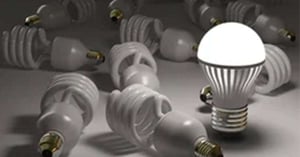
The biggest difference between LED and fluorescent lighting is how each technology produces light.

Fluorescent lighting uses gas-discharge technology. Electrical current passes through mercury vapor inside the lamp, producing ultraviolet (UV) radiation that interacts with a phosphor coating to create visible light. Most fluorescent systems also require ballasts to regulate voltage and maintain stable operation.

LED lighting uses semiconductor technology. A Light Emitting Diode (LED) produces visible light when an electrical current moves through semiconductor material. Unlike fluorescent systems, LEDs are solid-state lighting technology and do not rely on mercury vapor, plasma generation, or UV conversion processes.

This distinction affects nearly every aspect of lighting performance, including:

    • Energy consumption
    • Heat generation
    • Maintenance requirements
    • Fixture lifespan
    • Lighting controls compatibility
    • Environmental impact
    • Operational reliability

Why Are LEDs More Energy Efficient Than Fluorescent Lights?

LED lighting delivers higher energy efficiency because it wastes less energy during light production and directs light more effectively toward occupied spaces.

Fluorescent fixtures emit light in 360 degrees. Because of this omnidirectional output, reflectors and fixture housings must redirect much of the light toward the intended area. That process creates system losses and reduces real-world efficiency.

LEDs naturally emit directional light across roughly 180 degrees, which significantly improves useful lumens and overall system efficiency.

According to the original comparison data:

    • LED system efficiency commonly exceeds 50 lumens per watt
    • Fluorescent system efficiency often falls below 30 lumens per watt after accounting for fixture and reflector losses.

This difference becomes especially important in large commercial environments such as:

In these facilities, lighting often operates for 10–24 hours per day, making efficiency improvements highly impactful for utility costs and rebate eligibility.

Upgrade Beyond Fluorescent and CFL Lighting

LED lighting delivers major advantages over fluorescent and CFL systems, from improved energy efficiency and lighting quality to reduced maintenance and longer fixture life. If you're considering modernizing your lighting, explore our Turnkey Commercial LED Lighting Retrofit & Upgrade Services to see how Stouch Lighting supports complete LED upgrade projects from product selection through implementation.

When you're ready to evaluate your facilities, request a lighting upgrade consultation with our experts to discuss the best LED solution for your spaces, goals, and budget.

👉 Explore Turnkey Commercial LED Lighting Retrofit & Upgrade Services
👉 Request a Lighting Upgrade Consultation

Why Do Commercial Facilities Prefer LED Lighting in 2026?

Commercial facilities increasingly prefer LED lighting because it supports broader operational, financial, and sustainability goals.

Modern commercial buildings now prioritize:

    • Energy reduction targets
    • ESG reporting initiatives
    • Smart building integration
    • Predictive maintenance strategies
    • Occupant comfort
    • Reduced maintenance labor
    • Utility rebate optimization

LED systems align directly with those priorities.

Many LED fixtures also integrate with:

    • Occupancy sensors
    • Daylight harvesting systems
    • Luminaire-Level Lighting Controls (LLLC)
    • Networked Lighting Controls (NLC)
    • Building Automation Systems (BAS)
    • Energy Management Systems (EMS)

Fluorescent systems were not originally designed for this level of interoperability and automation.

Additionally, utility rebate programs increasingly reward advanced LED control packages because controls reduce runtime as well as wattage consumption. In many commercial rebate programs, controls can dramatically improve project payback periods and total incentive value.

How Do Maintenance Costs Compare Between LED and Fluorescent Lighting?

LED lighting significantly reduces maintenance costs compared to fluorescent systems.

Fluorescent lighting systems require:

    • Lamp replacements
    • Ballast replacements
    • Troubleshooting of flicker and startup failures
    • Disposal procedures for mercury-containing lamps

LED systems eliminate many of those recurring maintenance issues.

The source material highlights that LED systems can operate for 25,000–200,000 hours before replacement is needed, while fluorescent systems often require replacement between 7,000 and 15,000 hours.

This difference matters most in facilities where maintenance access is difficult or expensive, including:

In these environments, labor costs frequently exceed the material cost of the lamp itself.

Why Are Fluorescent Lights Being Phased Out?

Fluorescent lighting continues to decline due to energy regulations, maintenance concerns, and environmental compliance requirements.

One of the largest disadvantages is mercury content. Fluorescent lamps contain mercury vapor, which creates disposal challenges and environmental risks if lamps break during operation or replacement.

Additional issues include:

    • Ballast failures
    • Flickering
    • Warm-up periods
    • Reduced efficiency over time
    • Poor cold-weather performance
    • Lower compatibility with advanced lighting controls

As energy codes continue evolving, many commercial facilities now view fluorescent systems as outdated infrastructure.

Organizations pursuing sustainability certifications, such as ENERGY STAR or LEED v4.1, are increasingly prioritizing LED retrofits due to their lower energy consumption and longer operating life.

7 lights leds are putting out of businessHow Do LED Lighting Rebates Impact Retrofit Projects?

Commercial lighting rebates continue to accelerate LED adoption nationwide.

Many utility programs now prioritize:

    • LED fixture retrofits
    • LED-to-LED upgrades
    • Networked lighting controls
    • Occupancy-based controls
    • Daylight harvesting systems
    • Advanced dimming systems
    • DLC-listed fixtures and controls

Lighting controls rebates in 2026 are especially aggressive because utilities recognize that controls reduce lighting runtime as well as fixture wattage.

For commercial facilities, rebates can help offset:

    • Fixture procurement costs
    • Installation labor
    • Controls integration
    • Commissioning expenses
    • Smart building upgrades

Facilities that combine LEDs with advanced controls often achieve the fastest ROI and highest incentive values.

Which Commercial Applications Benefit Most from LED Retrofits?

Almost every commercial facility type benefits from LED retrofits, but some applications see especially strong returns.

Warehouses and Distribution Centers

High operating hours and tall mounting heights make maintenance reduction extremely valuable.

Schools and Universities

LEDs improve lighting quality while reducing maintenance disruptions and operating costs across large campuses.

Healthcare Facilities

Healthcare buildings benefit from improved reliability, controllability, and reduced maintenance requirements.

Parking Lots and Garages

LEDs provide improved visibility, stronger uniformity ratios, and better compatibility with photocells and smart controls.

Manufacturing Facilities

Industrial facilities benefit from reduced energy demand and improved lighting performance for operational visibility and safety.

How Do LED and Fluorescent Lighting Technologies Compare Across Performance Categories?

Category

LED Lighting

Fluorescent Lighting

CFL Lighting

Winner

CCT

2200K–6000K

2700K–6500K

2700K–6500K

Tie

CRI

Broad range, often 65–95

Typically 62–80

Typically 62–80

LED

Cycling

Instant-on; strong for frequent switching

Can flicker or wear faster with frequent switching

Lifespan drops with frequent switching

LED

Dimming

Strong dimming range with compatible drivers

Depends on ballast

Limited and model-dependent

LED

Directionality

Directional, 180° output

Omnidirectional, 360° output

Omnidirectional, 360° output

LED

Efficiency

Highest system efficiency

Efficient, but lower system efficiency

Better than incandescent, lower than LED

LED

UV Emissions

Virtually none

Produces UV internally

Produces UV internally

LED

Failure Pattern

Gradual lumen depreciation

Flickering, cycling, color shift, or burnout

Flickering, cycling, or burnout

LED

Lifespan

50,000–100,000+ hours

7,000–15,000 hours

Around 10,000 hours

LED

Maintenance

Minimal

Relamping and ballast replacement

Lamp replacement

LED

Upfront Cost

Higher

Lower

Low

Fluorescent/CFL

Shock Resistance

Strong solid-state design

Fragile glass tube

Fragile glass lamp

LED

Cold Weather

Strong performance

Reduced performance

Reduced performance

LED

Warm-Up Time

Instant

Short warm-up possible

Noticeable warm-up possible

LED

Warranty

Often 5–10 years

Typically shorter

Typically shorter

LED

Outdoor/Winter Use

Strong with proper fixture design

Limited

Limited

LED


Why Does This Comparison Matter for Commercial Buildings?

The shift from fluorescent and CFL technology to LED lighting goes far beyond basic energy savings. Modern commercial facilities now prioritize long-term operational efficiency, reduced maintenance demands, improved lighting quality, sustainability goals, and smarter building performance. LED systems support those priorities by delivering longer operating life, stronger system efficiency, better controllability, and lower lifecycle costs compared to older lighting technologies.

As energy codes become stricter and commercial buildings continue modernizing infrastructure, LED lighting has evolved from a simple retrofit option into a core component of high-performance building operations.

What Should Commercial Facilities Consider Before Upgrading to LED?

Before beginning an LED retrofit project, commercial facilities should evaluate:

    • Existing fixture infrastructure
    • Operating hours
    • Utility rebate eligibility
    • Lighting controls opportunities
    • Fixture compatibility
    • Foot-candle requirements
    • Uniformity ratios
    • Maintenance labor costs
    • Smart building integration goals

Facilities should also evaluate whether advanced controls, such as occupancy sensing, daylight harvesting, or networked lighting controls, can enhance rebate value and accelerate ROI.

Product procurement also matters. Selecting DLC-listed fixtures, compatible drivers, and interoperable controls platforms can improve long-term flexibility while helping facilities qualify for incentive programs.

Conclusion

LED lighting has moved far beyond being a simple energy-efficient alternative to fluorescent technology. In 2026, LEDs function as a foundational component of smart commercial buildings, supporting energy management, automation, sustainability initiatives, predictive maintenance, and utility rebate optimization.

While fluorescent systems improved efficiency over older incandescent technologies, LEDs now outperform fluorescent lighting in nearly every major commercial performance category, including lifespan, maintenance, control integration, energy efficiency, environmental impact, and long-term operational cost.

If your facility is evaluating LED retrofits, lighting controls, or rebate opportunities, reach out to Stouch Lighting to discuss commercial lighting solutions designed to improve efficiency, reduce maintenance costs, and support long-term building performance.